All dahlia growers eventually learn the same thing: those big beautiful blooms need support. The first year I grew a dinnerplate dahlia, I learned this the hard way.
Between summer storms, heavy flowers, and plants that seem to grow taller almost overnight, staking is one of those jobs that may not feel so important in June, but will be absolutely critical by August.
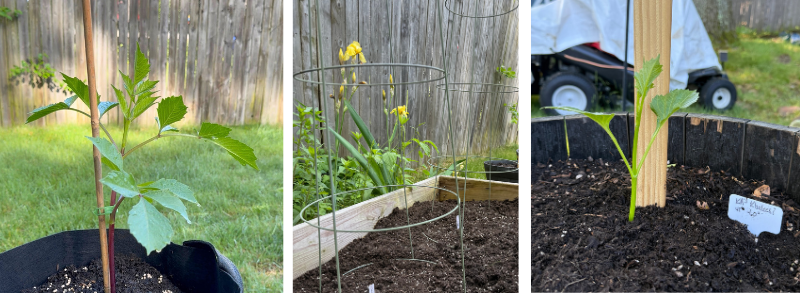
This year, I’m using three different methods to support my dahlias. I’ll let you know later how they each worked out.
First of all, I’m matching my stake to the expected height and bloom size of each variety. Some only need a little support. Others, that grow really tall, or produce large blooms need something a lot sturdier to keep them from falling over or snapping their stems throughout the season.
Here’s what I’m doing:
1. Bamboo Stakes for Smaller Dahlias
For my shorter varieties and smaller-flowered plants, I’m keeping things simple with bamboo stakes.
These are perfect for dahlias that grow under four feet or have lighter blooms that won’t become top-heavy later in the season. A single bamboo stake placed early allows me to loosely tie the main stem as the plant grows. If necessary, I can even add two more stakes later to create a triangle and tie them together at the top
I like this method because the stakes virtually disappear once the leaves fill in. It’s inexpensive, easy to adjust as needed, and works really well in my containers where space is limited.
For the smaller varieties, this is usually all the support I need.
2. Wooden Stakes for the Big Bloomers
For some of my taller varieties, or the ones that will produce large dinnerplate blooms, like Cafe au Lait, Labyrinth, or Bloomquist York, I’m using a mix of some green coated rebar or wooden furring strips that I had on hand. These will provide a much sturdier anchor than bamboo and give me confidence that it will keep the plant up when the heavy flowers start appearing.
For container gardening, these only work in the largest pots, like my half whiskey barrel, where there is plenty of soil to hold the stake in securely.
3. Camouflaged Tomato Cages for Extra Support
For a few of my taller or most vigorous varieties, I’m also experimenting with upside-down tomato cages.
The challenge with tomato cages is that the galvanized metal can look a little obnoxious. To help them disappear, I spray-painted mine with Rust-Oleum Camouflage paint before installing them. I photograph my flowers, a lot, so for me, this is an important step.
Once the paint dried, I flipped the cages upside down and secured the wider end into the soil. The wider base at the bottom gives the cages more stability and the muted finish will blend into the foliage as the plant grows.
The cage is perfect for providing support from multiple angles as the plant fills out. This method is really helpful for plants that may face strong winds, or produce heavy blooms, or multiple branching stems.
The Goal Isn’t Perfection
One thing I know for sure, every season is an experiment. These may not be the most glamorous solutions, but they’re practical, affordable, and I was able to reuse materials I already had on hand. That’s always a win in my book.
Because here’s what else I know. Some dahlias end up taller than expected, others come up short. A storm blows in, a stem leans, and all of the sudden you’re trying to add support you didn’t think you needed.
That’s why I try to stake when I plant and adjust as needed. It might not be a perfectly engineered flower farm setup. But as a backyard, weekend gardener, I’m just trying to give each plant enough support to thrive while keeping the garden looking as natural and relaxed as I can.
If those supports can help keep a few more dahlia blooms standing tall in August, that’s good enough for me.